September 29, 2026. ElevenLabs released Eleven v4 and a low-latency variant, Eleven v4 Turbo, on September 28, and for anyone running an AI receptionist or an outbound voice agent the number that matters is on its API pricing page: v4 Turbo lists at $0.04 per 1,000 characters, the same as its Flash model, and costs $0.011 until October 12 under a 72 percent launch discount. v4 lists at $0.08 and is $0.022 until the same date. ElevenLabs calls Turbo its best model for real-time use and agents, at about 100 ms of latency and 90+ languages, against about 75 ms and 32 languages for Flash.
Key numbers
| Item | Number |
|---|---|
| Eleven v4 and v4 Turbo release date | September 28, 2026 |
| v4 Turbo list price (same as Flash) | $0.04 per 1,000 characters |
| v4 Turbo price until October 12, 2026 (72 percent off) | $0.011 per 1,000 characters |
| v4 list price ($0.022 until October 12) | $0.08 per 1,000 characters |
| v4 Turbo latency, ElevenLabs figure (about 150 ms to first speech in its tests) | about 100 ms |
| Flash latency and languages | about 75 ms, 32 languages |
| Languages in v4 and v4 Turbo | 90+ |
| Audio needed for an Instant Voice Clone | 10 seconds |
| Price cut on older models since Sept 16 (Flash $0.05 to $0.04, v3 $0.10 to $0.08) | 20 percent |
| ElevenAgents additional call minute (burst minutes $0.16) | $0.08 |
| Concurrent calls, Creator and Business plans | 10 and 40 |
Prices and limits read on 29 September 2026 from ElevenLabs' API, ElevenAgents and launch pages; September 16 prices from our own earlier read.
What launched on September 28
- Two models. The launch post introduces v4 as the company's most emotive text to speech model and v4 Turbo as the same technology tuned for low-latency uses such as agents, built to run with its ElevenAgents platform.
- Latency, on ElevenLabs' own tests. A median inference latency of about 100 ms for Turbo, and a median time to first speech of about 150 ms over WebSocket streaming, measured in September against Cartesia, xAI, Google and OpenAI speech models with network latency removed.
- Languages and cloning. Both models support more than 90 languages, and an Instant Voice Clone now needs 10 seconds of audio.
- Where it runs. Both models are live in ElevenAgents, ElevenCreative and the API. The ranking claims in the post, first on Artificial Analysis' voice leaderboard and about 75 percent preference in blind tests, are the vendor's.
What it costs per character and per call minute
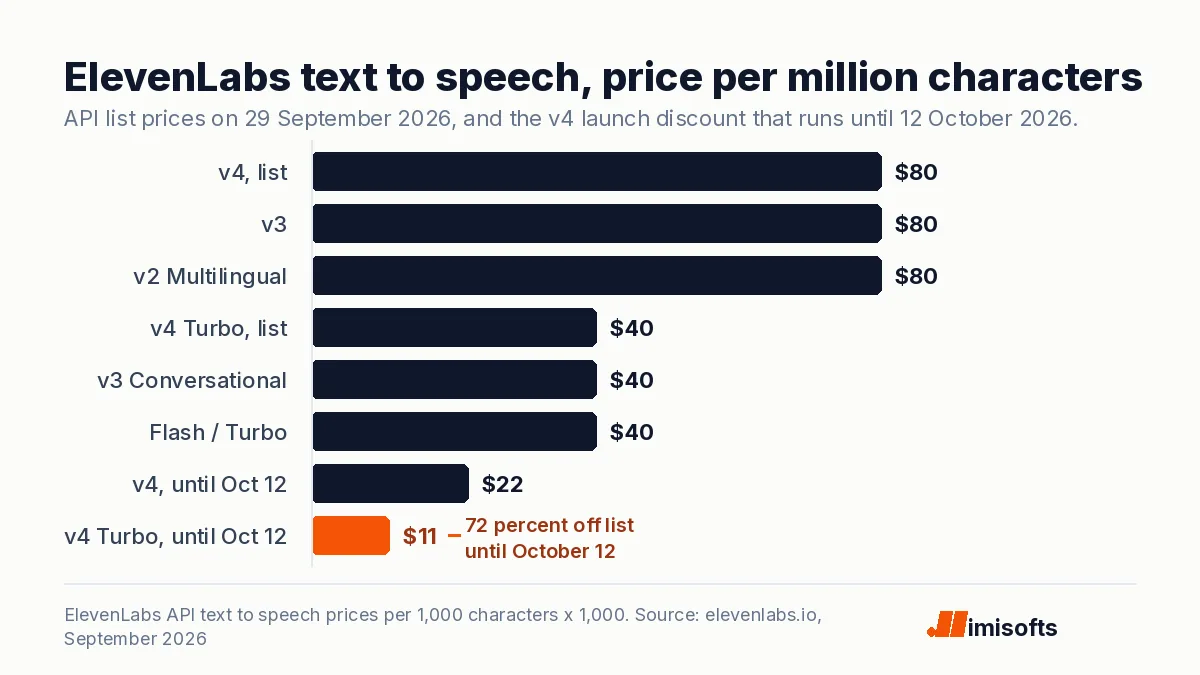
The API page, read on September 29, prices speech per 1,000 characters: v4 and v3 at $0.08, v2 Multilingual at $0.08, v4 Turbo, v3 Conversational and Flash at $0.04. Per million characters that is $80 for the first three and $40 for the second three at list, and $22 and $11 for the two v4 models until October 12. The older models are also cheaper than they were. When we priced the same page on September 16 for our AI phone call cost breakdown, Flash and v3 Conversational were $0.05 and v3 and v2 Multilingual $0.10 per 1,000 characters, so each has fallen 20 percent. The launch post does not mention a price change, so we cannot date it.
Hosted agents are billed per minute instead. The ElevenAgents pricing page lists one hosting rate, $0.08 per additional call minute, on every plan from Free to Business, with burst minutes at $0.16, text messages at $0.003, the language model billed at cost and your telephony provider's charges excluded. Plans run from 15 included minutes and 4 concurrent calls on Free, through 275 minutes and 10 concurrent calls on the $22 Creator plan, to 12,375 minutes and 40 concurrent calls on the $990 Business plan. The page shows no separate v4 line.
What it means for operators
At list prices v4 Turbo costs the same per character as Flash, so the choice for a phone agent is no longer about price: it is about 25 ms of extra model latency, on ElevenLabs' figures, in exchange for more expressive speech and 90+ languages instead of 32. That trade favours businesses whose callers do not all speak English. The October 12 discount makes a real test cheap, so run v4 Turbo on your own recorded call flows and time the full turn, speech recognition plus model plus voice, because a caller hears the total, not the text to speech figure. Ten seconds of audio is now enough to clone a voice, so get written consent before cloning a staff member and keep it with the agent's settings. If your agent speaks through Twilio's Say verb, Twilio chooses the ElevenLabs model for you, as our Twilio ElevenLabs voices note explains, so check what it offers before planning around v4. For a business that wants every missed call answered in the caller's own language, that is the after-hours call answering we build for home services firms, and our AI voice agents work covers outbound and intake.
Frequently Asked Questions
Eleven v4 Turbo is the low-latency version of ElevenLabs' Eleven v4 text to speech model, released on September 28, 2026 for real-time uses such as voice agents. ElevenLabs lists it at about 100 ms of latency with support for more than 90 languages, and it is available in ElevenAgents, ElevenCreative and the API.
On the ElevenLabs API it lists at $0.04 per 1,000 characters, or $40 per million, and costs $0.011 per 1,000 characters until October 12, 2026 under a 72 percent launch discount. Eleven v4 lists at $0.08 per 1,000 characters and is $0.022 until the same date.
The ElevenAgents pricing page lists one hosting rate, $0.08 per additional call minute, on every plan, with burst minutes at $0.16, the language model billed at cost and telephony charges excluded. It shows no separate line for v4.
Not on ElevenLabs' own figures. Its API pricing page lists Flash at about 75 ms and v4 Turbo at about 100 ms. Turbo trades a little latency for more expressive speech and more than 90 languages, against 32 for Flash, at the same list price per character.