Short answer. Not in the generative sense, by the publisher's own account: Take-Two CEO Strauss Zelnick told GamesIndustry.biz on February 3, 2026 that "generative AI has zero part in what Rockstar Games is building" with Grand Theft Auto VI (GTA 6), which Rockstar lists for release on November 19, 2026 on PlayStation 5 and Xbox Series X|S. That is a separate matter from traditional game AI, the decision logic that steers non-player characters, which a Rockstar job ad lists as a game technology area. Take-Two does use AI elsewhere: Zelnick has described it in mobile game levels and in test ads that cost about $800 a spot, against $25,000 to $50,000 for an agency-made one, per YouTube's automatic transcript of the WSJ video.
On 16 November 2026 we read Take-Two's prepared remarks for five earnings calls (fiscal Q2 2026 to fiscal Q2 2027), its annual report on Form 10-K for the year to March 31, 2026, Rockstar's GTA VI page, terms of service and two job ads, and the video of Zelnick's interview at The Wall Street Journal's tech conference, through YouTube's automatic transcript, which can mishear words. The "zero part" line comes from an interview, not an earnings call: across those five sets of prepared remarks the word AI appears once. We found no written Rockstar statement on AI in GTA VI.
Key numbers
| Item | Number |
|---|---|
| Generative AI's part in GTA 6, per Take-Two's CEO (GamesIndustry.biz interview, February 3, 2026) | Zero |
| GTA 6 release date on PS5 and Xbox Series X|S (Rockstar's GTA VI page) | November 19, 2026 |
| Agency-made 30-second mobile game ad (WSJ conference video published November 4, 2026, auto transcript) | $25,000 to $50,000 |
| Comparable ad made with off-the-shelf AI (1.6% to 3.2% of the agency price) | About $800 |
| Take-Two full-time employees (9,998 in development studios, March 31, 2026 (10-K)) | 12,909 |
| Game industry pros using generative AI at work (GDC, November 2026; 36% a year earlier) | 40% |
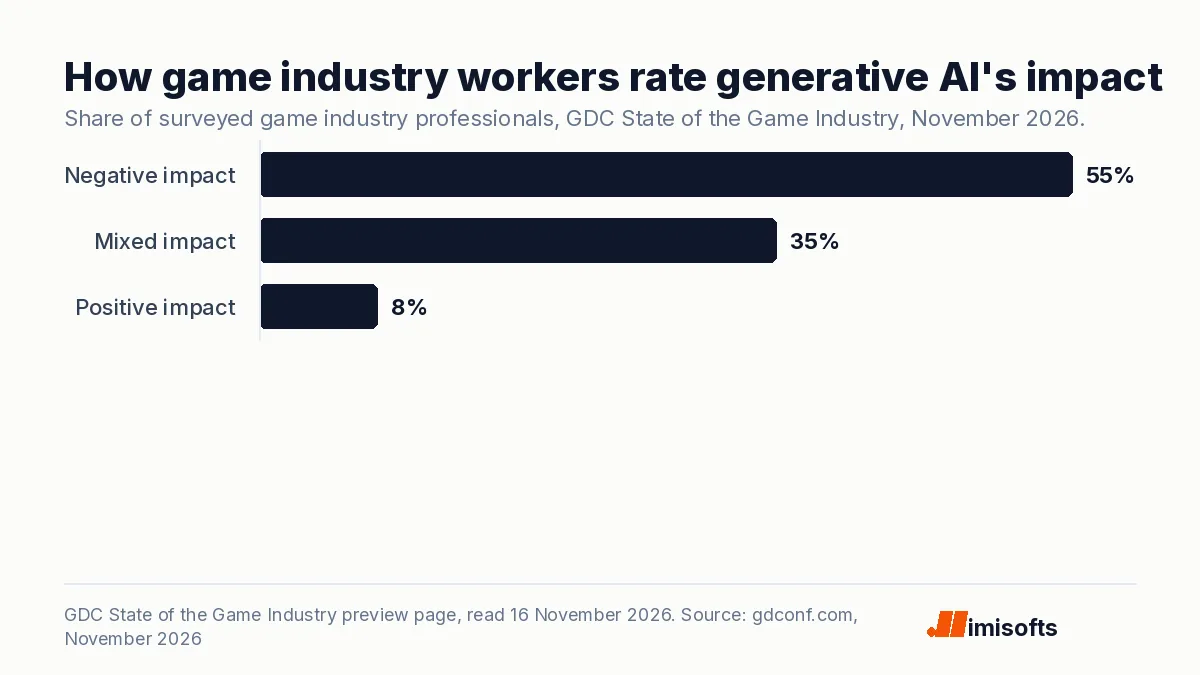
| Say generative AI is hurting the game industry (GDC, November 2026; 35% mixed, 8% positive) | 55% |
| Ontario job ads must disclose AI screening from (employers with 25 or more employees) | January 1, 2026 |
Rockstar's GTA VI page, Take-Two's 10-K and earnings remarks, GamesIndustry.biz, WSJ's conference video, GDC's survey preview and Ontario's employment standards guide, all read on 16 November 2026.
What Take-Two's CEO has said about AI, in order
Take-Two and its CEO have addressed AI on the record at least five times since October 2025. Read in order, the position is consistent: AI in the tools and the business, none of the generative kind in Rockstar's game.
| Date | Where | What was said, in short |
|---|---|---|
| October 28, 2025 | CNBC tech summit, New York | Intellectual property made with AI is "not protectable"; AI could not produce an equivalent of the GTA marketing plan and would give something "pretty derivative". |
| February 3, 2026 | GamesIndustry.biz interview | Generative AI has "zero part" in GTA 6; Rockstar's worlds are handcrafted and not procedurally generated; Take-Two runs "hundreds of pilots and implementations" of AI. |
| February 2026 | Fiscal Q3 2026 prepared remarks | Take-Two will keep investing in new technology, "particularly AI", for efficiencies that free its talent to focus on innovation. |
| May 22, 2026 | Annual report on Form 10-K | AI in its products and industry may bring operational, reputational, financial and competition risks. |
| November 4, 2026 | WSJ tech conference video | "Grand Theft Auto is handcrafted"; AI is "a mixed term" because players say they do not want anything called AI in their games; cost savings so far "relatively small". |
The newer remark that some outlets read as a hint came at the WSJ conference. TweakTown headlined that Zelnick "alludes" to AI behind GTA 6, but its own article says he did not confirm any specific use of AI in the game. In the video, after calling GTA handcrafted, he says Take-Two has been in the AI and machine learning business for a long time and is trying everything it can to make better games more efficiently. Insider Gaming quotes the same words.
Rumor versus record: what is confirmed
| Claim | What the record shows |
|---|---|
| Generative AI wrote, drew or built GTA 6 | Take-Two's CEO says no ("zero part", February 2026). No company source we read says otherwise. |
| Zelnick admitted at the WSJ that AI was used on GTA 6 | Not in the video. He called the game handcrafted, then spoke about Take-Two's use of AI in general. |
| Rockstar issued its own denial | No written statement on Rockstar's site. IGN reported on August 29, 2026 that Kinda Funny's Greg Miller asked Rockstar at a preview event and was told there is "no AI" in the game. That is a verbal answer, reported secondhand. |
| Take-Two does not use AI at all | Wrong by its own account: AI pilots across the company, AI in mobile games and test ads, and a 10-K that says it invests in AI tools. |
Some coverage goes further than the record. An Insider Gaming writer wrote that GTA 6 will have used AI somewhere in its pipeline; that is the writer's opinion, not a company statement.
Generative AI versus the game AI that runs NPCs
Two different technologies share the name. Generative AI makes new material. Rockstar's terms of service, last updated February 28, 2025, define generative AI tools as programs that use AI or machine learning to create content such as code, text, images, music or a human-sounding voice from prompts. That is what Zelnick ruled out for GTA 6.
Traditional game AI is older and narrower. It is decision logic that designers write so non-player characters (NPCs) react to the world. Epic Games' Unreal Engine documentation describes its behavior trees as a way to create AI for non-player characters: the tree checks a list of facts, called a Blackboard, and picks a branch. Its own examples run from a cockroach that flees when a light turns on to a bot that takes cover, shoots and looks for pickups. This is the kind of logic that lets a game's pedestrians and drivers react to the player.
Rockstar has not published how GTA 6's NPC systems work. Its job ad lists artificial intelligence among game technology areas, next to animation, audio, navigation and physics. So a game can have plenty of AI in the old sense and none of the generative kind; Take-Two's statements are about the second. The difference is that game AI chooses among behaviors people built, while generative AI produces lines, images or sounds that no person wrote, drew or recorded.
Where Take-Two and Rockstar do use AI
The line Take-Two draws runs between the product and the work around it. Here is what the company and Rockstar have said, area by area.
| Area | AI use described | Source |
|---|---|---|
| GTA 6 art, writing and world | None of the generative kind; built street by street | GamesIndustry.biz, Feb 2026 |
| Company-wide | Hundreds of pilots, including in studios; some generative tools already saving cost and time | GamesIndustry.biz, Feb 2026 |
| Mobile games | AI used where games have so many levels that content repeats | WSJ video, Nov 2026 |
| Marketing | Test of off-the-shelf AI for 30 and 60 second live-action style ads | WSJ video, Nov 2026 |
| Player content moderation | Filters may use AI or machine learning (section 7.5) | Rockstar terms |
| Hiring in Toronto | Job ad says AI is not used to screen candidates | Rockstar job ad |
The marketing test is the most concrete number Take-Two has given. Zelnick said Take-Two studios in Turkey paid a local agency with human actors $25,000 to $50,000 for each 30-second mobile game ad, then made comparable spots with off-the-shelf AI software at about $800 each, which let the team make many versions and test them. On those figures the AI spot cost 1.6% to 3.2% of the agency price. He added that this was about marketing, not development, and that across Take-Two's cost base the savings so far have been relatively small. The figures come from the auto-generated transcript of the WSJ video.
The work is still done by a large staff. Take-Two's 10-K counts 12,909 full-time employees at March 31, 2026, of whom 9,998, about 77%, work in development studios. The same filing says it invests in AI tools to enhance game play and anticipate changes in consumer behavior, and lists AI as a risk factor.
What game developers say about generative AI
Take-Two's caution matches the mood in the industry. GDC's State of the Game Industry: November 2026 preview, from the organizers of the GDC Festival of Gaming, reports these results from its global survey of game industry professionals, with a US breakout:
| Measure | Share of respondents |
|---|---|
| Use generative AI tools as part of their job | 40% (36% a year earlier) |
| Of those users, use it daily | 57% |
| Daily use among business operations and services staff who use it | 71% |
| Say generative AI is having a negative impact on the industry | 55% |
| Say the impact is mixed | 35% |
| Say the impact is positive | 8% |
| Negative view among QA and community support staff | 76% |
GDC adds that many respondents see value in generative AI for repetitive tasks, research, brainstorming and early prototyping, while there is still large opposition to using it for creative or player-facing features. The preview page does not give the total sample or name a sponsor; GamesIndustry.biz reported that the report drew on more than 2,600 game industry professionals. Treat it as a survey of people who chose to answer, not a census.
The business lesson: AI in operations, people on the product
Take-Two says generative AI has no part in GTA 6, and describes AI use around it: repetitive levels in mobile games, ad variants to test, moderation at scale. Its reasons are written down, and most apply to any company.
- Customers. Zelnick said players say they do not want anything called AI in their games. If your buyers feel the same about your core product, a hidden AI shortcut is a brand risk, and the 10-K lists "negative user perceptions" of AI as a risk.
- Ownership. Zelnick told CNBC that intellectual property made with AI is not protectable; that is his view. Take-Two's 10-K is more careful and calls ownership of AI-generated assets uncertain, since courts and lawmakers have not settled it.
- Data. The 10-K warns that staff, contractors or vendors may paste confidential, personal or regulated information into third-party AI services.
- Quality. The same filing says AI tools may produce biased, incorrect or inappropriate content.
The practical rule for a business deciding where AI fits: sort your work into the core product, which customers judge you on, and operations, which customers rarely see. Start AI in operations, such as support triage, lead routing, data entry, reporting and drafting ad variants for testing, where a mistake is caught internally and the time saved is easy to measure. Keep people as the authors and approvers of the core product. A company whose product is itself an AI service will draw the line differently, but it should still draw one.
Measure before you claim savings. Take-Two runs hundreds of pilots, and its CEO still calls the savings relatively small for a company of its size. A timed baseline for each workflow, taken before you automate, tells you whether a pilot paid off.
A short checklist for your own AI decisions
- List your ten most common workflows and mark each one product or operations.
- Pick one operations workflow with steady volume, such as the support inbox or lead routing, and time it for two weeks before you change anything.
- Write a one-page rule on what staff may paste into third-party AI tools, the risk Take-Two names in its 10-K.
- Run AI-made marketing as a test, the way Take-Two's studio did: label it, measure it, and keep a person in charge of approval.
- If you hire in Ontario and have 25 or more employees, public job ads posted since January 1, 2026 must say whether you use AI to screen, assess or select applicants, according to Ontario's employment standards guide. A Rockstar Toronto job ad we read says it does not.
- Name the person who signs off on anything customers see, and write that down.
Where imisofts fits
imisofts is a Dubai agency that builds AI automations and AI agents for operations work, such as support triage, lead routing, CRM updates and reporting, often on n8n, along with AI voice agents. If you want help sorting your workflows and building the first one, see our AI automation services; if you need an engineer inside your own team to build and maintain them, you can hire an AI engineer. We would start with one workflow and a timed baseline, so you can judge the result on your own numbers.
Frequently Asked Questions
Not generative AI, according to Take-Two. CEO Strauss Zelnick told GamesIndustry.biz on February 3, 2026 that generative AI has zero part in what Rockstar Games is building with GTA 6 and that its worlds are handcrafted. Games also use traditional game AI to control non-player characters, which is a different technology, and a Rockstar job ad lists artificial intelligence as a game technology area.
Non-player characters in games are steered by traditional game AI: decision logic, such as behavior trees, that designers build. That is not generative AI. Rockstar has not published how its NPC systems work, but a Rockstar job ad lists artificial intelligence among game technology areas, and Take-Two's CEO says generative AI has no part in the game.
No. In WSJ's video of the interview, published November 4, 2026, he said Grand Theft Auto is handcrafted, then said Take-Two has long worked with AI and machine learning and is trying everything it can to make games more efficiently. He did not name any use of AI in GTA 6, and TweakTown, which headlined that he alluded to it, says the same.
Yes, outside GTA 6's creative work. Zelnick has described hundreds of AI pilots across the company, AI in mobile games with many repetitive levels, and a test of AI-made mobile game ads at about $800 a spot against $25,000 to $50,000 for agency spots, per YouTube's automatic transcript of his WSJ interview. He also said the cost savings so far have been relatively small.
Rockstar's Terms of Service, last updated February 28, 2025, say the license does not allow using its services or content to develop, train, enhance or provide source material for generative AI tools, and that such uses are prohibited.
GDC's November 2026 State of the Game Industry preview says 40% of surveyed game industry professionals use generative AI tools in their job, up from 36% a year earlier, while 55% say it is having a negative impact on the industry. The preview page does not give the total sample.