October 12, 2026. Claude Managed Agents, Anthropic's hosted agent runtime, bills two things: the model's standard token rates and $0.08 per session-hour of running time, according to Anthropic's pricing page. On October 9 Anthropic added dynamic workflows in beta, which let one agent write a program that runs up to 1,000 agents in phases, 64 at a time, and its workflow documentation says a run "has no price of its own". For a 500-document review on Claude Sonnet 5.5, that puts the bill near $12, almost all of it tokens.
Key numbers
| Item | Number |
|---|---|
| Session runtime (billed only while running) | $0.08 per session-hour |
| Web search inside a session | $10 per 1,000 searches |
| Claude Sonnet 5.5 tokens | $2 in, $10 out per 1M |
| Claude Haiku 5.5 tokens (prompts up to 100,000 tokens) | $0.10 in, $0.50 out per 1M |
| Claude Opus 5.5 tokens | $4 in, $20 out per 1M |
| Threads working at once in one run (not guaranteed) | 64 |
| Agents over a run's life | 1,000 |
| Default run lifetime | 24 hours |
| Open runs per session (default) | 10 |
| US-only inference | 1.1x token prices |
| 500-document review on Sonnet 5.5 (4M input, 400,000 output, 2 hours runtime) | about $12.16 |
| Dynamic workflows beta | October 9, 2026 |
Prices and limits read on 12 October 2026 from Anthropic's pricing page, Managed Agents workflow runs documentation and release notes; per-job costs at list prices.
What Anthropic shipped on October 9
- Dynamic workflows, in beta. Per the release notes, an agent with workflows turned on can write a workflow, a program that runs many agents in phases and combines their results, and the server runs it in the background. It needs the managed-agents-2026-04-01 beta header and the multiagent_20261001 setting with workflows enabled.
- Only the agent starts a run. You tell it in the system prompt when to start one, then follow progress through workflow_run events on the session's event stream.
- Limits. 64 threads working at once in one run, 1,000 agents over a run's life, a 24-hour default lifetime and 10 open runs per session by default. Anthropic says the 64 is not guaranteed and can change.
- Budgets. A run's model requests count toward the session's budget. At the budget every open run pauses, and raising or removing the budget resumes it.
How Managed Agents is billed
- Tokens at each model's standard rates, with the usual prompt caching multipliers. Claude Sonnet 5.5 is $2 per million input and $10 per million output tokens, Claude Haiku 5.5 $0.10 and $0.50 for prompts up to 100,000 tokens, Opus 5.5 $4 and $20.
- Session runtime at $0.08 per session-hour, metered to the millisecond and only while the session is running. Idle time waiting for your next message or a tool confirmation is not billed.
- Web search inside a session at $10 per 1,000 searches.
- No Batch discount, because sessions are stateful and interactive, and tokens cost 1.1x when you pin inference to the US.
Verdent's independent pricing guide describes the same $0.08 runtime charge, billed only while a session runs.
What a 500-document review costs
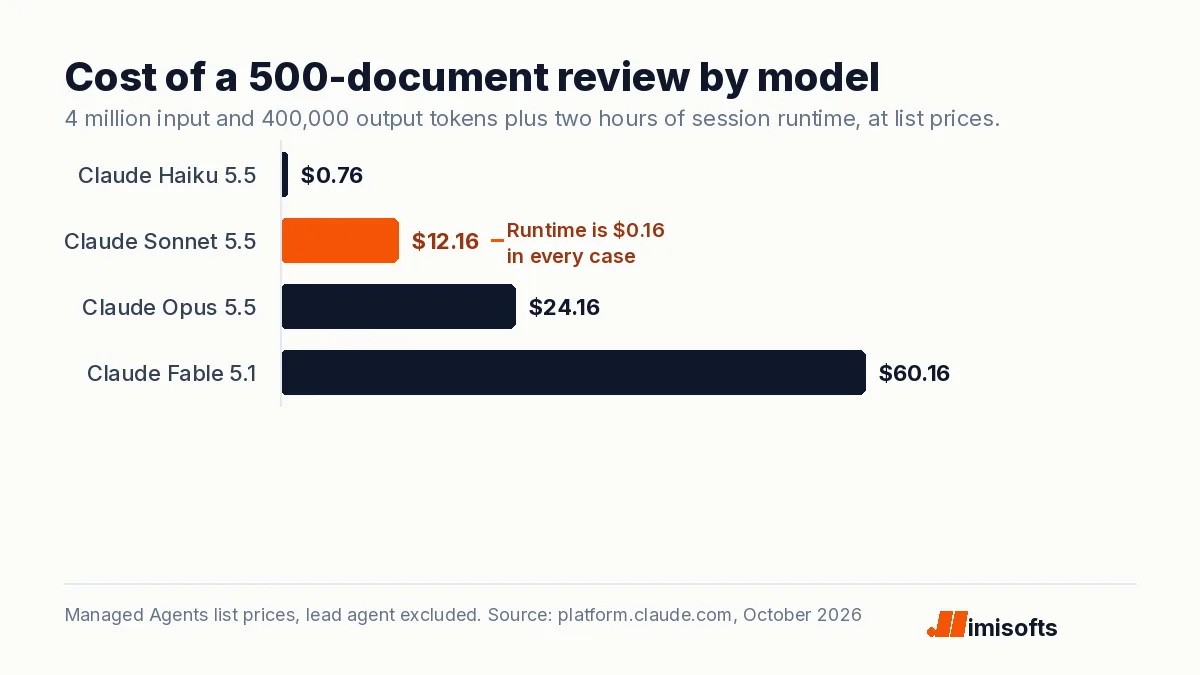
Say a workflow hands 500 intake documents to 500 agents, each reading about 8,000 tokens and writing an 800-token summary. That is 4 million input and 400,000 output tokens. Add two hours of session runtime, $0.16. At list prices the job costs about $0.76 on Haiku 5.5, $12.16 on Sonnet 5.5, $24.16 on Opus 5.5 and $60.16 on Claude Fable 5.1, which lists at $10 and $50 per million. The runtime line is the same in every case; the model choice is the bill. The lead agent that writes the workflow and merges the summaries adds its own tokens on top.
What it means for operators
Fan-out is the new cost lever. A workflow that quietly starts 1,000 agents multiplies whatever each one reads, so set a session budget before the first real run, put extraction on Haiku and save Sonnet or Opus for the judgment step. For a law firm sorting a week of intake, that is the difference between pennies and tens of dollars per batch, which is how we scope AI intake for law firms. We first wrote about the runtime fee when Anthropic put its own inbound sales agent on Managed Agents; agencies building these for clients can bring in an AI engineer to set budgets and model routing before handing over the keys.
Frequently Asked Questions
Model tokens at Anthropic's standard rates plus $0.08 per session-hour of running time, metered to the millisecond. Web search inside a session costs $10 per 1,000 searches, and idle time is not billed.
There is no separate fee. Anthropic's documentation says a run has no price of its own: the tokens its agents use are billed like the session's other tokens, and session runtime is billed as usual.
Up to 1,000 agents over a run's life, with 64 threads working at once, a 24-hour default lifetime and 10 open runs per session by default. Anthropic says the 64 limit is not guaranteed and can change.
No. Anthropic lists the Batch API discount among the modifiers that do not apply, because sessions are stateful and interactive. Pinning inference to the US multiplies token prices by 1.1.