Short answer. In a seller-financed business purchase, the seller lets you pay part of the price later under a promissory note, usually with interest, while you pay the rest at closing from cash or a bank loan. If an SBA 7(a) loan pays for the rest, SBA SOP 50 10 8.1, effective October 1, 2026, requires a buyer contribution of at least 10% on an initial acquisition, and a seller note may count toward no more than half of that 10% if it is subordinated to the lender and on full standby: no principal or interest payments for the term of the SBA loan.
This guide explains how a seller note works, what the SBA rules mean for your down payment, how online business marketplaces handle staged payments, and how the IRS treats the note for the seller. Every rule and sourced number links to its page; the worked example is our own arithmetic.
Key numbers
| Item | Number |
|---|---|
| SBA minimum buyer contribution (Initial acquisition, of total project cost) | 10% |
| Share a standby seller note can cover (Of the required contribution, limited sources) | Up to half |
| Full standby means (No principal or interest for the 7(a) loan term) | No payments |
| Seller debt can be refinanced after (In place and current) | 36 months |
| SBA 7(a) maximum loan (sba.gov 7(a) page) | $5 million |
| Seller-financed share, business-for-sale deals (Or more; BizBuySell, July 31, 2025) | 10% to a third |
| Down payment, seller-financed online deals (Empire Flippers market data) | 60-70% |
| Brokers seeing delays from 2025 SBA changes (BizBuySell Q2 2025 Insight Report) | 41.3% |
SBA SOP 50 10 8.1 (effective October 1, 2026), sba.gov, IRS Publication 537 (2025), BizBuySell and Empire Flippers pages, all read November 27, 2026.
How seller financing works when you buy a business
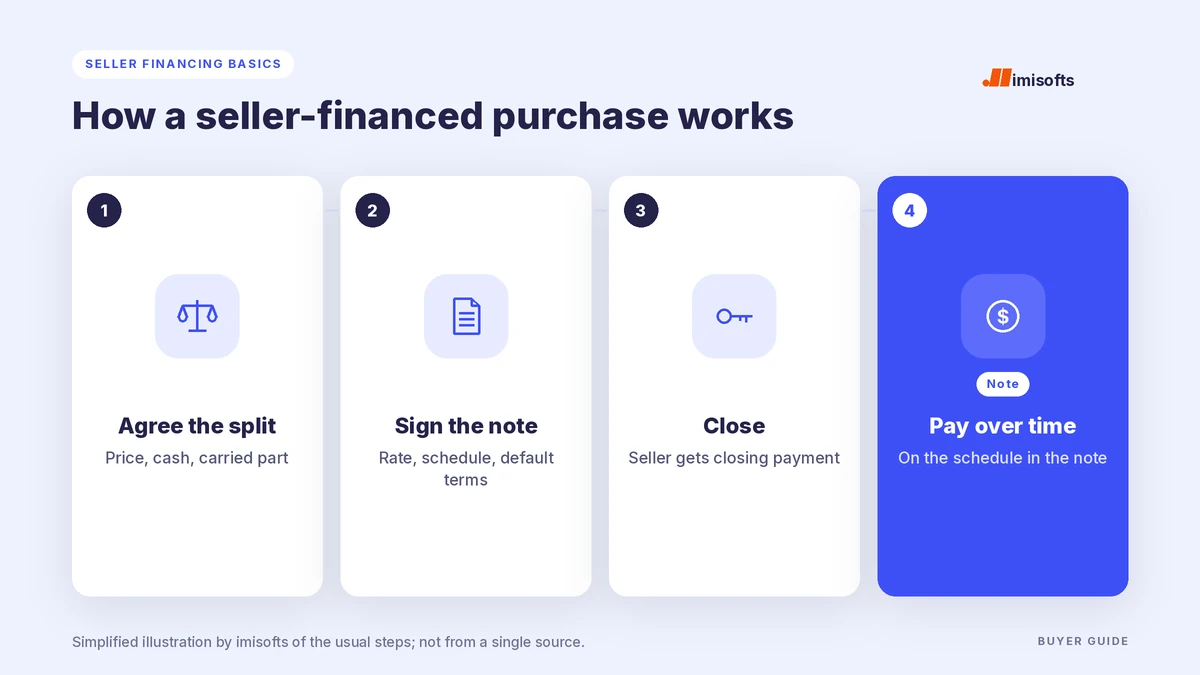
Seller financing (also called owner financing or a seller carry back) replaces part of the cash a buyer would otherwise bring or borrow. In outline:
- Agree the price and the split. Buyer and seller agree the total price, the amount paid at closing and the amount the seller will carry.
- Sign a promissory note. The buyer signs a note to the seller for the carried amount, with an interest rate, a payment schedule and what happens on a missed payment.
- Close. The seller receives the closing payment and hands over the business.
- Pay the note over time. The buyer pays the seller on the schedule in the note.
Empire Flippers, a marketplace for online businesses, describes the same structure on its seller financing page (dated November 12, 2026): the seller receives part of the price upfront, "the buyer essentially becomes the borrower while the seller becomes the 'lender' of the remaining capital."
For the seller, the note means less cash at closing; BizBuySell describes seller financing as a way to help close transactions and attract qualified buyers. For the buyer, it means a smaller payment at closing.
For sale by its founder
Looking for a lead generation agency to buy?
imisofts, which publishes this guide, is for sale: the website, the cold email system that brings in its leads, and its monthly retainer clients, in one direct deal with the founder.
How much of the price a seller usually carries
There is no fixed share. Two marketplaces describe it:
- Business-for-sale deals. BizBuySell, a business-for-sale marketplace, wrote on July 31, 2025 that sellers traditionally offer financing for a portion of the deal, anywhere from 10% to a third or more.
- Online businesses. For seller-financed deals, Empire Flippers tells buyers to be prepared to offer a down payment of around 60-70% of the purchase price, "according to our market data." Its own example is a $700K Amazon FBA business with $500K paid upfront and 10 monthly payments of $20K, so the seller is paid in full within 10 months.
In Empire Flippers' own example, the carried $200K was paid within 10 months. Neither source publishes a typical interest rate, and we did not find a primary source that does, so the rate is a point to negotiate rather than a number to look up.
Seller notes and SBA 7(a) loans: the 2026 rules
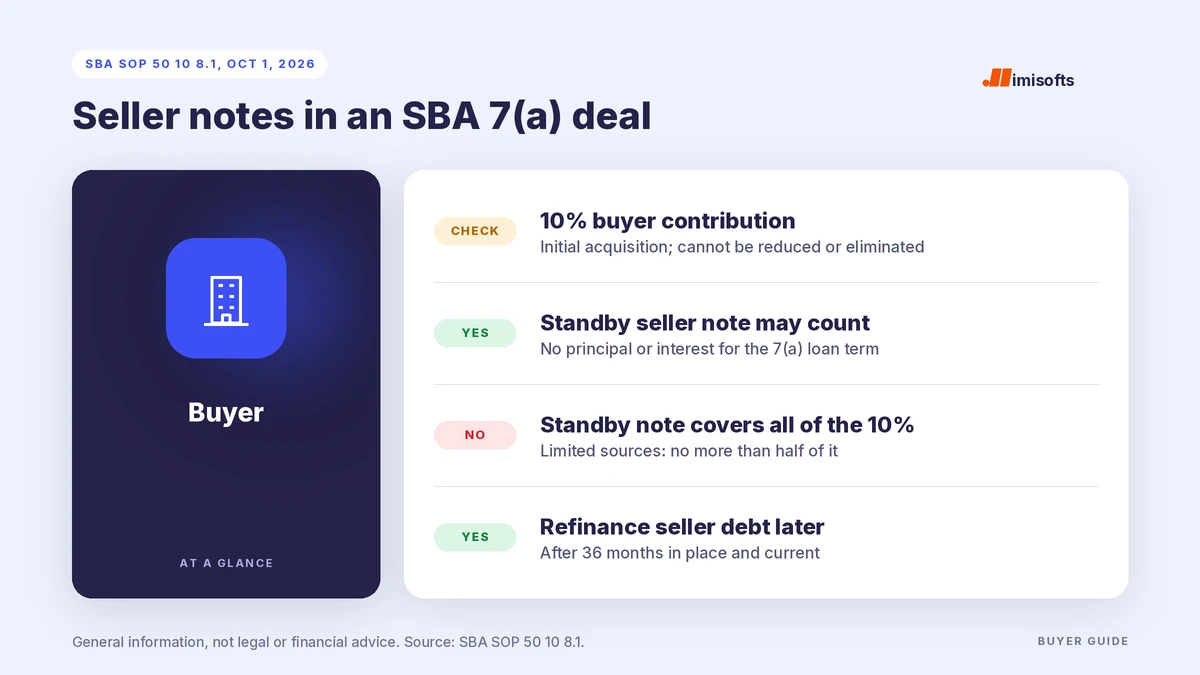
In the US, one bank route is an SBA 7(a) loan, which goes up to $5 million. When a 7(a) loan funds the purchase, the lender follows the SBA's Standard Operating Procedure, SOP 50 10. The current version, 8.1 with technical updates, took effect on October 1, 2026; version 8 took effect on June 1, 2025. The SOP sets these rules for seller notes in a change of ownership:
| Rule | What SOP 50 10 8.1 says |
|---|---|
| Minimum buyer contribution | 10% for an initial acquisition, which "cannot be reduced or eliminated." Also 10% for business expansions and owner buyouts, where the lender may reduce or eliminate it if it finds the borrower has enough liquidity and working capital after the deal. |
| What the 10% is measured on | Total project cost for most changes of ownership; the purchase price for an owner buyout. |
| Seller note as part of the 10% | May be considered equity if it is subordinated to the lender and on full standby: no principal or interest payments for the term of the 7(a) loan. |
| Cap on limited sources | Limited sources, including standby seller debt, may provide no more than half of the required injection. |
| Interest on a standby note | May accrue and be amortized after the 7(a) loan is paid in full. |
| Paperwork | SBA Form 155 or the lender's equivalent standby agreement, with the note attached. |
| Total debt | All debt for the purchase, including seller debt not on full standby, is limited to the business valuation and must be supported by debt service coverage. |
| Refinancing the seller note | Possible after it has been in place and current for 36 months. |
Two things follow from this. First, a seller note on full standby is patient money: the seller receives no principal or interest from it until the SBA loan is repaid. Second, a seller note that is paid monthly alongside the SBA loan is still possible, but it does not count toward your 10%, and the lender adds its payments to the debt the business must be able to carry.
The previous version, SOP 50 10 8 of June 2025, already slowed some deals. BizBuySell's July 31, 2025 post, citing its Q2 2025 Insight Report, said 41.3% of business brokers saw the SBA loan policy changes causing delays in closing, 36.1% reported no impact and 22.7% were unaware of the changes.
This is general information, not legal, tax or financial advice; check your deal with a lawyer or accountant.
A worked example: an $800,000 purchase with an SBA loan
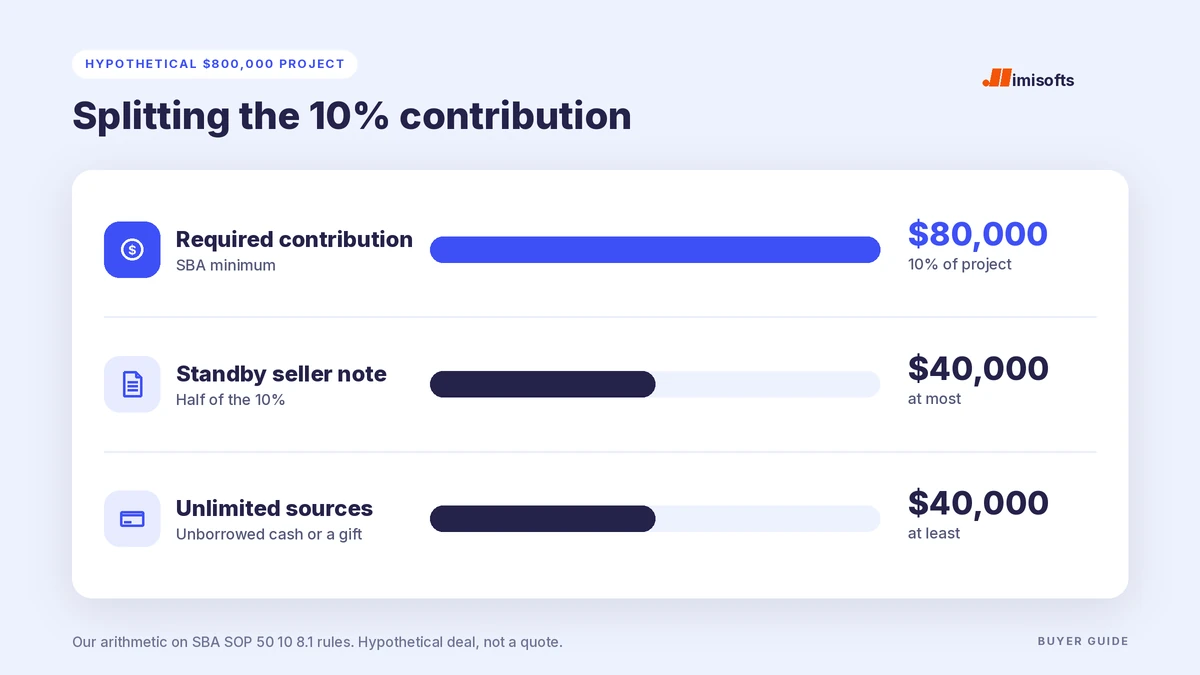
Take a hypothetical initial acquisition with a total project cost of $800,000, funded with an SBA 7(a) loan. Our arithmetic on the SOP rules:
| Piece | Amount | How it is set |
|---|---|---|
| Required buyer contribution | $80,000 | 10% of $800,000 |
| Most a standby seller note can cover | $40,000 | Half of the $80,000 |
| Least from unlimited sources | $40,000 | For example cash that is not borrowed, or a gift |
Now suppose the seller also carries a separate $120,000 note that is not on standby, at a hypothetical 7% rate over five years. Its payment would be about $2,376 a month, or about $22,569 of interest over the five years. That payment sits on top of the SBA loan payment, so the lender tests whether the business's cash flow covers both.
The numbers above are illustrations of how the rules combine, not a quote.
This is general information, not legal, tax or financial advice; check your deal with a lawyer or accountant.
Seller financing for websites and online businesses
Online businesses are listed on marketplaces such as Flippa, Empire Flippers and BizBuySell, and sometimes directly from a founder, as with the imisofts agency sale.
Looking at its marketplace, Empire Flippers says cash upfront "remains the most popular option for small business sales." It sold 168 businesses in 2025; more than a quarter had earnouts, deal structures were rare below $100K, and about half of the businesses it sold for $100K or more had an earnout. An earnout, where part of the price depends on later results, is a different structure from a seller note. When a deal includes financing, Empire Flippers says its team helps buyers and sellers understand the promissory note and manage repayments and reconciliations.
On Flippa, staged payments can run through FlippaPay or Escrow.com. Its help page on milestone payments (May 3, 2025) gives examples such as 50% upfront and 50% after 30 days, or 70% at closing and 30% after a training period.
A staged payment and a seller note are not always the same thing. Ask whether the later payments will be held in escrow or simply owed under a note.
How the IRS treats a seller note
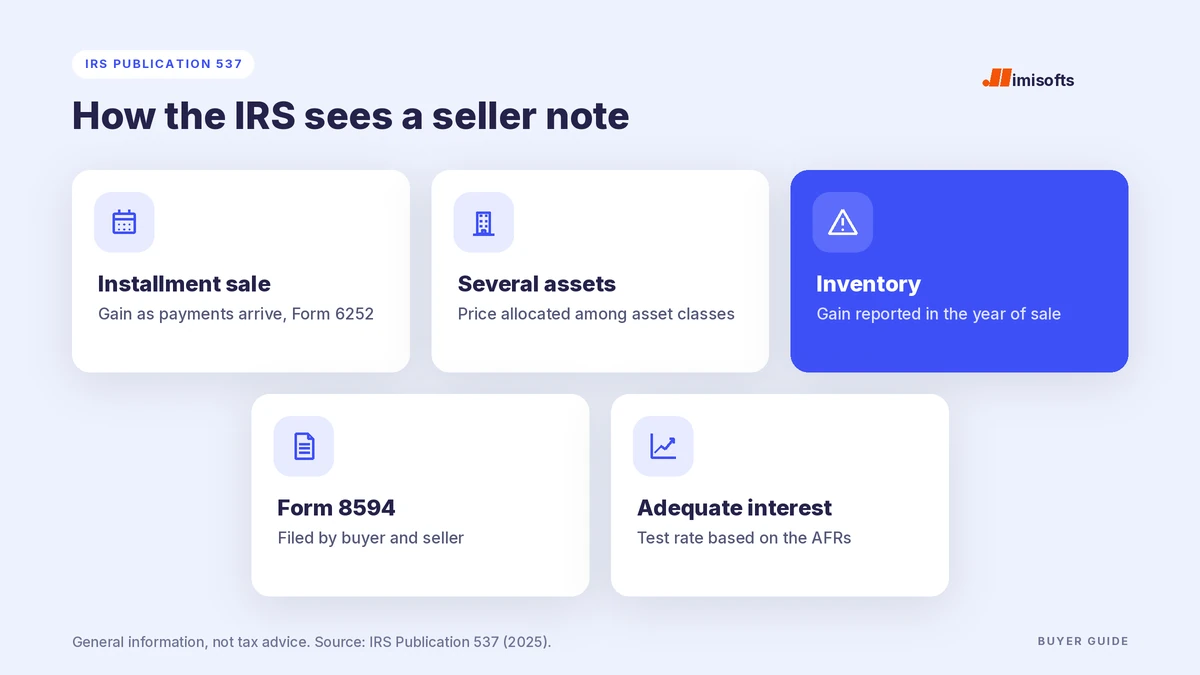
For a US seller, a seller-financed sale is an installment sale if at least one payment arrives after the tax year of the sale. IRS Publication 537 defines it as "a sale of property where you receive at least one payment after the tax year of the sale," and says the seller may be able to report part of the gain as each payment arrives, on Form 6252. Each payment usually has three parts: interest income, return of basis and gain.
Three rules matter for the deal itself:
- A business is several assets. The IRS says the installment sale of an entire business "isn't the sale of a single asset." The price and payments are allocated among classes of assets, and the sale of inventories of personal property cannot use the installment method, so that gain must be reported in the year of sale even if paid later.
- Both sides file Form 8594. Buyer and seller report how the price is allocated among section 197 intangibles and other business assets.
- The note needs adequate interest. If the stated rate is lower than the test rate, which is based on the applicable federal rates the IRS publishes each month, part of the principal may be recharacterized as interest.
This is general information, not legal, tax or financial advice; check your deal with a lawyer or accountant.
What to check in a seller note before you sign
Based on the rules above, we suggest buyers and sellers settle these points in writing:
- Amount, rate and schedule, and what each payment covers.
- Standby or not, and if an SBA loan is involved, whether the note's terms are in the lender's credit memo, which the SOP requires.
- Security, and whether the seller's rights are subordinated to the bank's.
- What counts as default, and what the seller can do if payments stop.
- The handover, such as training or a transition period, if part of the price depends on it.
- The price allocation for Form 8594, agreed by both sides.
This is general information, not legal, tax or financial advice; check your deal with a lawyer or accountant.
Disclosure: imisofts, which publishes this guide, is itself for sale. If you are looking for a lead generation and AI automation agency to buy, see what is included.
Frequently Asked Questions
The seller lets you pay part of the price after closing under a promissory note, usually with interest, while you pay the rest at closing from cash or a loan. You then pay the note on the schedule agreed in it.
Partly. Under SBA SOP 50 10 8.1, a seller note that is subordinated to the lender and on full standby, with no principal or interest paid for the term of the 7(a) loan, may be considered equity toward the 10% contribution, but limited sources can provide no more than half of it.
At least 10% of the total project cost for an initial acquisition, a minimum that cannot be reduced or eliminated. On an $800,000 project that is $80,000, of which at most $40,000 can come from a standby seller note.
BizBuySell wrote in July 2025 that sellers traditionally finance anywhere from 10% to a third or more of the deal. In seller-financed online deals, Empire Flippers tells buyers to be prepared to put down around 60-70% of the price, based on its market data.
Under SOP 50 10 8.1, seller debt from a change of ownership is eligible to be refinanced after it has been in place and current for 36 months.
Not always. IRS Publication 537 says a seller may be able to report gain on an installment sale as payments arrive, on Form 6252. Gain on inventories of personal property cannot use the installment method and must be reported in the year of sale.