Bing’s AI Performance report shows how often Microsoft Copilot, Bing’s AI summaries and select partner AI apps cite your pages, which pages they cite and the grounding queries behind them. On imisofts.com, from 16 to 28 September 2026, the ten pages Copilot cited most and the ten pages Google sent the most clicks shared no page at all. If you only read Search Console, you do not know which of your pages Copilot is citing.
On 14 September I published the opposite result for Google: nine of the ten pages its AI features showed most on my site already earned clicks, so AEO and SEO were the same job. That was a Google finding. It did not survive Bing.
Bing’s 3-month view shows citations on 13 days, 16 to 28 September, and zero on every day before. On 2 October I pulled Search Console for the same 13 days and joined the two on the URL. Bing logged 1,062 citations for my site. Google logged 130 clicks and 2,027 AI feature impressions. Bing counts Copilot, its own AI summaries and the partner apps together; I call the total Copilot below.
Google’s AI shows my law guides. Copilot quotes my software reviews. Same site, same 13 days, no page in both top tens.
Key numbers
| Item | Number |
|---|---|
| Copilot citations, imisofts.com, 16 to 28 Sep 2026 (Bing AI Performance chart total) | 1,062 |
| Pages in Bing’s cited-pages list for that window (all blog posts, no service page) | 41 |
| Citations for the most cited page, the Apollo review | 181 |
| Google clicks to that page, same 13 days | 1 |
| Pages in both top tens, Copilot and Google clicks | 0 |
| Pages in both top tens, Copilot and Google AI features | 0 |
| Google clicks to Copilot’s ten most cited pages (of 130 site clicks) | 4 |
| Copilot citations for a page Google has not crawled (Discovered, currently not indexed) | 39 |
| Citation Share, apollo.io b2b contact data accuracy (19 citations) | 51.35% |
| Google AI feature impressions, same 13 days | 2,027 |
| Google clicks to the site, same 13 days | 130 |
| Newest day of Bing AI data when read on 2 Oct | 28 Sep |
Read on 2 October 2026 from the imisofts.com AI Performance report in Bing Webmaster Tools and from Google Search Console, both set to 16 to 28 September 2026.
The mistake: reading one console for every AI engine
It is tempting to run AI search reporting off Google alone. Its generative AI report is free and sits beside your clicks, so it feels like the whole picture. It is one engine’s picture. In my console it has four tabs (pages, countries, devices and days), no click column and no query column, so it cannot tell you what you were asked.
Bing’s report answers that. A grounding query is, in Bing’s words, a key phrase the AI used when retrieving content that was cited in its answer, and its help page adds that these are grouped phrases, not full user questions or prompts. Beside each sits a Citation Share, which Bing defines as the percentage of citations attributed to your site out of all citations shown for that phrase.
If Google’s AI features show a page, Copilot will cite it too.
On my site the two top tens shared no page over the same 13 days.
Export both, join them on the URL, compare the top tens.
Bing also shows grounding phrases, which Google’s AI report does not.
What Copilot cited, and what Google did with the same pages
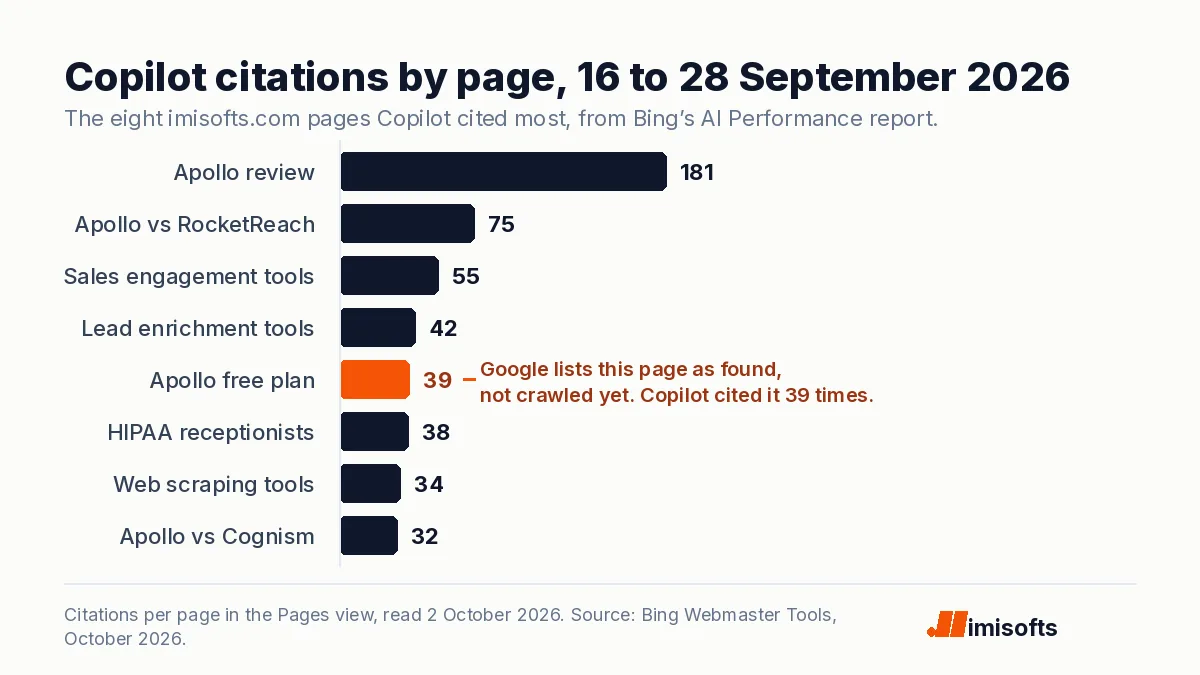
These are the eight pages Copilot cited most, against what Google did with the same URLs in the same window.
| Page on imisofts.com | Copilot citations | Google clicks | Google AI feature impressions |
|---|---|---|---|
| Apollo review | 181 | 1 | 3 |
| Apollo vs RocketReach | 75 | 0 | 6 |
| Sales engagement platforms | 55 | 0 | 20 |
| Lead enrichment tools | 42 | 0 | 8 |
| Apollo free plan limits | 39 | 0 | 0 |
| HIPAA AI receptionists | 38 | 0 | 4 |
| Web scraping tools | 34 | 0 | 26 |
| Apollo vs Cognism | 32 | 0 | 0 |
Window: 16 to 28 September 2026, read on 2 October from Bing Webmaster Tools (AI Performance, Pages view) and Google Search Console (Performance and the generative AI features report).
Copilot’s ten most cited pages earned 4 Google clicks between them, out of 130. Google’s ten most clicked pages, eight of them cold email law guides, drew 14 Copilot citations between them. Against Google’s AI features the result was the same: the two top tens shared no page.
The ten grounding phrases that brought the most citations all read like software buying research. “apollo.io b2b contact data accuracy” brought 19 citations at a 51.35 per cent share, so more than half of the citations Bing showed for that phrase were mine. “apollo vs rocketreach email verification accuracy comparison” brought 14 at 35.90 per cent, and “hipaa compliant ai customer support platform pricing” 29 at 24.58 per cent.
Copilot quoted a page Google has not crawled
My Apollo free plan limits page drew 39 Copilot citations in those 13 days and no Google impressions at all. Its URL Inspection on 2 October still reads “Discovered - currently not indexed”, which Google defines as found but not crawled yet, with no last crawl date. I have asked Google to index it twice.
Bing had that page and handed it to Copilot as a source 39 times while Google had not fetched it once. A page can be a working source in one AI engine and absent from the other’s index, and only the second console tells you which.
The engine quoting you most is quoting your last edit
The page Copilot cited most, my Apollo review, drew 181 citations, and for all 13 days it carried wrong figures. Until a re-check on 1 October it put Apollo’s database at 260M+ contacts, where Apollo states 240M+, and quoted Apollo’s accuracy claim as 93 per cent, where Apollo’s data page says 98. The page now says which way each error ran.
Bing’s guidance for this report is to keep content fresh and accurate, and it points to IndexNow to help AI systems reference the current version of a page. The pages that win a large share of citations for a buying phrase are the first ones to re-read.
Not one cited page is a service page
All 41 pages in Bing’s list are blog posts: no homepage, no service page. Google’s AI features at least surfaced 11 of my other URLs, the homepage and service pages among them, for 25 of their 2,027 impressions.
That is the gap I would close first, and it is the work we do under AI search optimization: find which pages each engine already quotes, then connect them to the offer they support.
Four moves for this week
Open AI Performance in Bing Webmaster Tools
Bing Webmaster Tools is free. Verify your site, open AI Performance (labelled Beta in my account) and expect a lag: on 2 October my newest day of data was 28 September.
Compare top tens, not totals
Export the Pages list and your Search Console pages for the same dates. Do not add Bing’s rows up: its help page says totals may differ across views, and mine came to 752 against 1,062. The Average Cited Pages tile averages every day in the range, including days with no citations, so my 3-month tile read 2 while 26 pages were cited on 25 September alone.
Re-read the pages that win the biggest shares
Sort grounding queries by Citation Share, filter by the top phrases to see which of your pages they pull, and check every figure on those pages against the vendor’s or regulator’s own page. Then submit the change through IndexNow.
Give your service page something to cite
Bing’s guidance names clear headings, tables, FAQ sections and data with sources. On my home-services page that is a table of what after-hours call answering costs, each price read from the vendor’s own page on 27 September 2026. Then link each top-cited post to the offer it supports.
The bottom line
Google and Copilot cited different parts of my site, and of the two consoles only Bing shows the phrases behind its citations. Check both for the same dates before you decide what to fix. For my site the answer was blunt: Copilot cited none of the pages that sell my services, and the page it cited most was out of date.