September 30, 2026. The European Commission has set the EU's new customs handling fee at €2 per item on goods sold online from outside the EU, and it lands on top of the €3 customs duty that has applied to low-value parcels since July 1. The amount is in Commission Delegated Regulation C(2026) 6694, adopted on September 21, and the Commission's customs reform page says the fee will be introduced by November 1, 2026. For a US, UK, Canadian or Australian brand that ships straight to EU customers, a €60 order holding a T-shirt and a watch, two items in customs terms, will carry €10 of EU charges before VAT once the fee applies: €6 of duty and €4 of handling fee.
Key numbers
| Item | Number |
|---|---|
| EU customs handling fee (Delegated Regulation C(2026) 6694, Article 1) | €2 per item |
| Temporary customs duty, consignments up to €150 (July 1, 2026 to July 1, 2028) | €3 per item |
| Commission target start for the handling fee (legally 10 days after the act enters into force) | November 1, 2026 |
| Objection window for Parliament and the Council (from notification of the act) | 30 days |
| Lower fee for customs warehouses for distance sales (amount not yet set) | from July 1, 2028 |
| Annual customs cost behind the fee (SWD(2026) 283) | €5.29 billion |
| Low-value e-commerce items imported in 2025 (98 percent of items imported) | about 5.9 billion |
| Distance-sales items, July 2026 against July 2025 | 60 percent fewer |
| Items checked by customs per million, 2025 (about 203 in 2022) | 65 |
| Product identifiers in these declarations | mandatory November 1, 2026 |
| Commission review of the fee (first assessment by September 21, 2027) | every two years |
| EU Customs Data Hub mandatory for e-commerce | July 1, 2028 |
Legal texts, Commission guidance and the Commission cost report read on 30 September 2026 on ec.europa.eu, taxation-customs.ec.europa.eu and eur-lex.europa.eu.
What the Commission decided
- The amount is €2 per item. Article 1 of the delegated regulation reads "EUR 2 per item". It supplements Regulation (EU) 2026/2108, the new Union Customs Code, signed on September 16 and published in the Official Journal on September 19.
- It covers every distance sale, not only parcels under €150. Article 20(2) of the Code charges the fee on goods sold in distance sales and released for free circulation in the EU. The Commission's explanatory memorandum says sales above €150 "are also subject to the handling fee", even though it sized the fee on the volume of items under €150. The €3 duty, by contrast, stops at €150.
- The start date depends on publication. The Code applies the fee 10 days after the delegated act enters into force (Article 287(4)), and the act enters into force on the day it is published in the Official Journal. Before that, Parliament and the Council have 30 days from notification to object (Article 282(7)), unless both confirm earlier that they will not. The Commission's target is November 1, 2026.
- The seller's side pays, not the shopper. The fee is owed by the debtor of the customs debt at import and paid to customs at least once a month (Article 20(5)). The Code's recitals say that until its new rules on importers for distance sales apply, that debtor is the declarant, typically the IOSS-registered seller or marketplace or an indirect customs representative, and that the consumer should not be a debtor. The fee is non-refundable (Article 20(6)).
- A lower rate for customs warehouses comes later. Goods sold from a customs warehouse for distance sales will pay a lower fee from July 1, 2028 (Articles 20(4) and 287(5)). This act does not set that amount.
- The €2 can move. The Commission must report on the underlying customs costs every two years (Article 20(8)) and assess by September 21, 2027 how the fee affects distance sales.
What €2 per item means on a real order
An item is a customs unit, not a count of pieces. The Code defines it as goods in one consignment that share the same tariff classification, description and, where required, origin (Article 5(78)). The Commission's guidance on the €3 duty gives the working example: five T-shirts are one item, a T-shirt and a watch are two. Applied to both charges from November:
- €45 order, three identical T-shirts: one item, so €3 of duty plus €2 of fee, €5 in all, about 11 percent of the order.
- €60 order, a T-shirt and a watch: two items, so €6 plus €4, €10 in all, about 17 percent of the order.
- €90 bundle of five products, each under a different tariff classification: five items, so €15 plus €10, €25 in all, about 28 percent of the order.
- €220 order, a jacket and gloves: above €150, so the flat €3 no longer applies and each product pays its normal tariff rate, plus €4 of handling fee.
VAT is a separate charge and this act does not change it. The pattern is plain: single-product orders absorb the new fee easily, mixed baskets of cheap goods do not.
Why the fee is €2
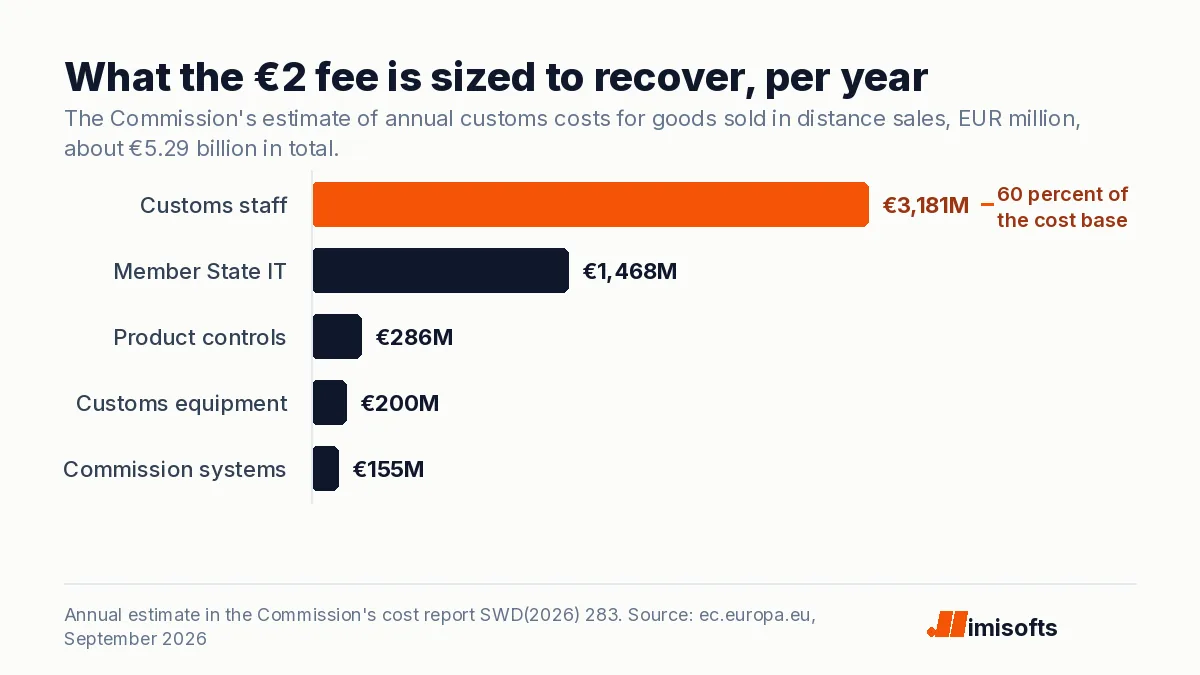
The Commission's cost report, SWD(2026) 283, puts the yearly cost of checking data, running risk analysis and controlling these goods at about €5.29 billion: €3.18 billion of customs staff, about 60 percent of the total, €1.47 billion of Member State IT systems, €286 million of extra product controls, €200 million of equipment and €155 million of Commission systems. The volume is the other half of the sum. About 5.9 billion low-value items entered the EU in 2025, 98 percent of all items imported, and in July 2026, the first month of the €3 duty, the Commission's surveillance data recorded 60 percent fewer distance-sales items than in July 2025. The report sketches what happens if only 40 percent of the 2025 flow continues, which is about 2.4 billion items a year. It does not print the division, but as an illustration, €5.29 billion over 2.4 billion items is roughly €2.20 an item. The Commission calls its method conservative because the volume it counts leaves out distance sales above €150, which also pay the fee.
The same report shows why customs wanted the money. Customs checked about 203 items in every million in 2022 and only 65 in 2025, as volumes rose far faster than controls.Il Sole 24 Ore reported on September 25 that €2 sits at the low end of a €2 to €4 range discussed in the weeks before, and that Italy's customs agency collected €83 million from the €3 duty in its first two months while imports fell 39 percent on the previous two months.
The other November 1 change: product identifiers
November 1 matters for a second reason. The Commission's €3 duty guidance says product identifiers become mandatory in these customs declarations from November 1, 2026, after a voluntary period that began on July 1, so customs can trace and block unsafe or non-compliant goods. The guidance does not say which identifier your carrier or broker will ask for, so ask now what it will send for each item and where it will pull it from, while there is still time to fix your product data. Targeted EU inspections in 2025 found that more than 60 percent of checked cosmetics, protective equipment, food supplements, toys and electronics failed EU standards, which tells you where the checks will look first.
What it means for operators
- Count items the way customs does. Your charge depends on how many distinct classifications sit in each parcel. Under the Code's definition, goods count as one item only when classification, description and, where declared, origin all match, so check that every product carries a correct HS code and that variants of one product share one description.
- Decide who carries the €5. On a single-item order the duty and fee together come to €5. You can fold that into EU prices, show it as a line at checkout, or raise your free-shipping threshold to cover it. If you sell on Shopify, a Shopify expert can set EU market pricing and duty collection so the choice is deliberate, and it is worth knowing that Shopify Managed Markets switched to collecting duties at checkout on August 24.
- Ask your carrier how it will bill the fee. The declarant owes it and settles with customs at least monthly, so if your carrier or broker declares your parcels, ask which account it will charge and from which date, before the first November invoice arrives.
- Re-run the EU warehouse math. The fee attaches to goods released for free circulation as distance sales. Stock imported in bulk and cleared before it is sold is an ordinary import that pays normal duty, so check with your broker how an EU fulfilment partner changes your per-order charges. The Code adds a separate, lower fee from July 2028 only for goods held in a customs warehouse for distance sales.
- If you build landed-cost tools, add the line now. Any app that quotes landed cost to EU shoppers needs the €2 per item before the start date, or merchants will find the gap in their margins first and then in the reviews for apps in the Shopify App Store.
- Watch the Official Journal. The legal start date is fixed only when the act is published, 10 days before it applies. Check for it in late October and plan around November 1.
The €3 duty runs until July 1, 2028, when normal tariffs return and the EU Customs Data Hub becomes mandatory for e-commerce imports, so this is the pricing regime for the next 21 months. Our explainer on the €3 duty covers how that charge works per tariff line. If you want your EU checkout, pricing and product data rebuilt around these numbers, that is our e-commerce work.
Frequently Asked Questions
€2 per item, set by Commission Delegated Regulation C(2026) 6694 of September 21, 2026. An item is goods in one consignment that share the same tariff classification, description and origin, so five identical T-shirts count once and a T-shirt plus a watch count twice.
The Commission's target is November 1, 2026. Legally the fee applies 10 days after the delegated act enters into force, which happens on publication in the Official Journal, after a 30-day window in which the European Parliament and the Council can object.
No. The €3 duty, in force from July 1, 2026 until July 1, 2028, is a customs duty per item on consignments up to €150. The handling fee is a separate €2 per item charge that covers customs processing costs. A one-item parcel under €150 pays both, €5 in total, before VAT.
The debtor of the customs debt at import pays it to customs at least monthly. Until the Code's rules on importers for distance sales apply, that is normally the declarant, such as an IOSS-registered seller or marketplace or an indirect customs representative. The Code says the consumer should not be a debtor.
Yes. The Code charges it on goods sold in distance sales from outside the EU, and the Commission's explanatory memorandum says sales above €150 are also subject to it. Those orders pay normal tariff rates instead of the flat €3 duty, plus the €2 per item fee.
The fee attaches to goods released for free circulation as distance sales. Stock imported in bulk and cleared before it is sold is an ordinary import that pays normal duty, so ask your broker how it applies to your setup. A separate, lower fee for goods sold from a customs warehouse for distance sales starts on July 1, 2028, and its amount has not been set.