October 5, 2026. Turkey regulates commercial email under Law No. 6563 on the Regulation of Electronic Commerce, in force since May 1, 2015, and the rule splits by recipient. Article 6(1) allows commercial electronic messages only with the recipient's prior consent, given in writing or by any electronic means, while Article 6(2) lets a sender message tradesmen and merchants (esnaf and tacir) without prior consent. The B2B exemption is narrower than it looks. Under the Regulation on Commercial Communication and Commercial Electronic Messages, as amended on January 4, 2020, every sender must register with İYS, the national Message Management System, and before relying on the merchant exemption must record the merchants' addresses in İYS and check there that none has refused. For 2026 the fine for a message sent without consent is TRY 2,859 to 14,309, and up to ten times that when one send reaches more than one person.
Key numbers
| Item | Number |
|---|---|
| Law No. 6563 on electronic commerce in force | May 1, 2015 |
| İYS rules added to the Regulation (Official Gazette No. 30998) | January 4, 2020 |
| Stop sending after a refusal (Law Article 8(3)) | within 3 business days |
| Consent and message records to keep (Regulation Article 13) | 3 years |
| Fine, message without consent, 2026 (Article 12(1)(a)) | TRY 2,859 to 14,309 |
| Multiplier when one send reaches several people (Article 12(2)) | up to 10x |
| Fine, missing sender identity or purpose, 2026 (Article 12(1)(b)) | TRY 2,859 to 28,620 |
| Fine, opt-out failures, 2026 (Article 12(1)(c)) | TRY 5,723 to 42,930 |
| Revaluation rate behind the 2026 table (Official Gazette December 25, 2025, No. 33118) | 25.49 percent |
Law No. 6563, its 2026 fine table and the Regulation read on mevzuat.gov.tr, with Moroğlu Arseven's summary, on 5 October 2026.
The five rules every commercial email to Turkey follows
- Consent, or the merchant exemption. Consumers need prior consent; merchants and tradesmen do not, but under Article 6(3) of the Regulation, once a merchant refuses, you need its consent before writing again.
- Register with İYS and check it before sending. Article 5(2) of the Regulation requires anyone who wants to send commercial electronic messages to register with İYS, Article 5(3) bars messages to recipients with no consent recorded there, and Article 6(6) requires merchant addresses to be recorded in İYS, with a refusal check, before a message goes out under the exemption. BTS and Partners quotes the system's operator: persons and companies inside or outside Turkey that want to send must register.
- Content that matches the consent and names you. Article 7 of the Law requires content consistent with the consent, details identifying the sender with reachable contact information such as a phone number and email address, the subject and purpose of the message, and on whose behalf it is sent.
- An easy, free opt-out, honoured in three business days. Under Article 8 a recipient may refuse at any time without giving a reason, the sender must make refusal easy and free by electronic means and explain how in each message, and sending must stop within three business days of the request. Article 9 of the Regulation says a refusal voids the consent for that channel, and recipients can also refuse through İYS.
- Proof kept for three years. Article 13 of the Regulation puts the burden of proof on the sender, who keeps consent records for three years after the consent ends, and other records for three years, for the Ministry of Trade.
The 2026 fines
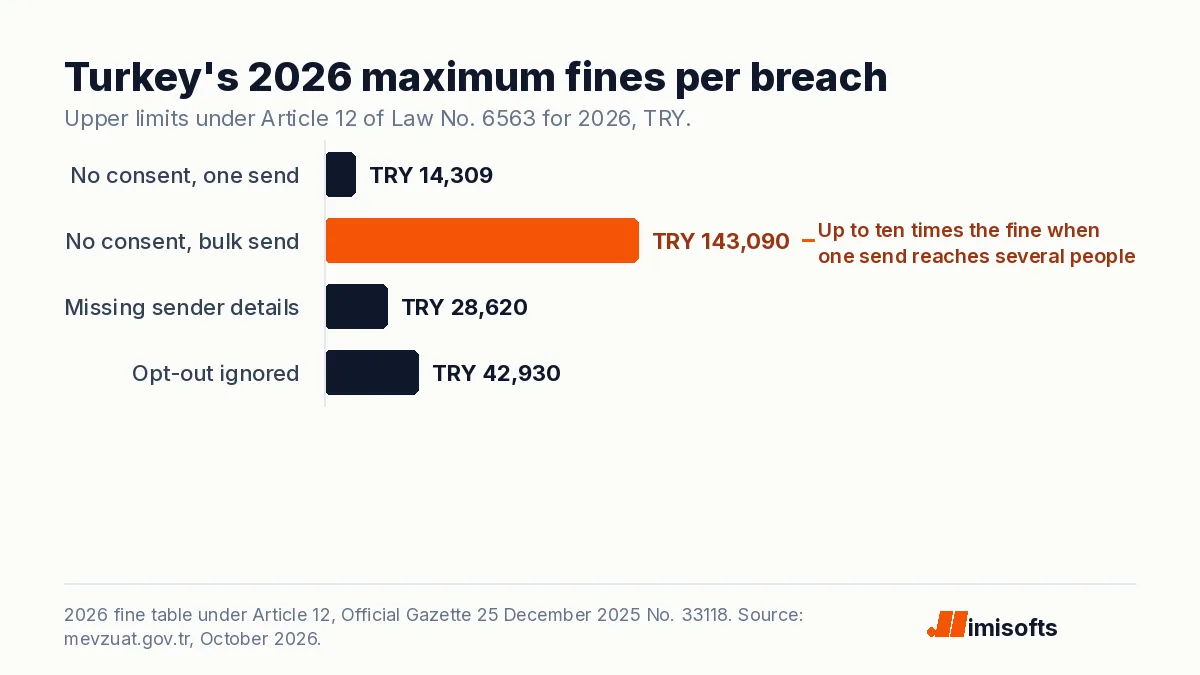
The Ministry of Trade revalues the Article 12 fine bands every year. The 2026 table, in force from January 1 to December 31, 2026, was published in the Official Gazette of December 25, 2025, No. 33118, using the 25.49 percent revaluation rate set for 2025, as Moroğlu Arseven summarizes. A message without consent, or with content that does not match the consent, costs TRY 2,859 to 14,309 under Article 12(1)(a), and Article 12(2) raises that up to ten times when a single send reaches more than one person, so up to TRY 143,090 at the 2026 ceiling. Missing sender identity, contact details, subject or purpose costs TRY 2,859 to 28,620 under Article 12(1)(b). Failing to offer an easy, free refusal, or to stop within three business days, costs TRY 5,723 to 42,930 under Article 12(1)(c). Complaints reach the Ministry through e-Devlet, İYS or its website.
What it means for operators
Turkey is one of the few markets where B2B cold email is lawful without consent and still administratively heavy: register with İYS, record the merchant addresses, confirm none has refused, then send emails that identify you, state their purpose and carry an opt-out you honour within three business days. Anything addressed to consumers needs consent recorded on İYS first. If an address names a person, Law No. 6698 on the Protection of Personal Data also applies. Turkish sending platforms are bound too: Article 11 of the Regulation stops an intermediary from starting a send for a sender that is not registered with İYS, and requires it to check recipients' consent on İYS first. Build the split into your data: tag each Turkish contact as merchant or individual, sync İYS status before every send, and log refusals with timestamps inside the sending stack, which is what our email infrastructure work is for. In our country-by-country table Turkey belongs with France in the group that allows business email with identification and opt-out duties, and our guide to which cold email law applies to you explains why the recipient's country decides. A Turkish campaign is a lead generation build that starts with İYS registration, not the list.
Frequently Asked Questions
To merchants and tradesmen, yes, without prior consent under Article 6(2) of Law No. 6563, but the sender must be registered with İYS, must record the merchant addresses there and must check that none has refused before sending (Regulation Articles 5(2) and 6(6)). Emails to consumers need prior consent recorded on İYS.
According to the system's operator, as quoted by BTS and Partners, yes: persons and companies that want to send commercial electronic messages to recipients in Turkey must register with İYS whether they are located in Turkey or abroad. Article 11 of the Regulation also stops Turkish intermediaries from starting a send for an unregistered sender.
TRY 2,859 to 14,309 per breach under Article 12(1)(a) of Law No. 6563, raised up to ten times, so up to TRY 143,090, when one send reaches more than one person. Missing sender details cost TRY 2,859 to 28,620 and opt-out failures TRY 5,723 to 42,930, per the table published in the Official Gazette of December 25, 2025.
Within three business days of receiving the refusal, under Article 8(3) of Law No. 6563 and Article 10 of the Regulation. Each message must explain how to refuse, the refusal must be easy and free, and recipients can also refuse through İYS, which voids the consent for that channel.