October 5, 2026. Argentina has no prior-consent rule for advertising email. It has a source, labelling and removal rule instead. Article 27 of Law 25.326 on personal data protection lets a business process data for advertising and direct sales when the data appear in publicly accessible documents, were provided by the people themselves or were obtained with their consent, and lets every person ask at any time to be withdrawn or blocked from the database. Decree 1558/2001 requires every advertising communication sent by mail, telephone, email or other remote means to state expressly and prominently that the recipient can ask for that removal, and Disposition 4/2009 of March 4, 2009 adds that unsolicited direct advertising must be flagged as advertising, with the single word "publicidad" in the header of an email. Since June 1, 2024, AAIP, the data protection authority, classes failing to remove a name and email address from an advertising database on request as a grave infraction.
Key numbers
| Item | Number |
|---|---|
| Prior consent for advertising email (if the source passes Article 27(1) of Law 25.326) | not required |
| Word required in an unsolicited email's header (Disposition 4/2009, Article 2) | publicidad |
| Disposition 4/2009 signed | March 4, 2009 |
| AAIP Resolution 126/2024 in force | June 1, 2024 |
| Fine for ignoring a removal request (grave) (plus up to 4 warnings and a 1 to 30 day suspension) | ARS 80,001 to 90,000 |
| Fine for a minor infraction (such as an unregistered database) | ARS 1,000 to 80,000 |
| Fine for a very grave infraction (plus closure or cancellation of the database) | ARS 90,001 to 100,000 |
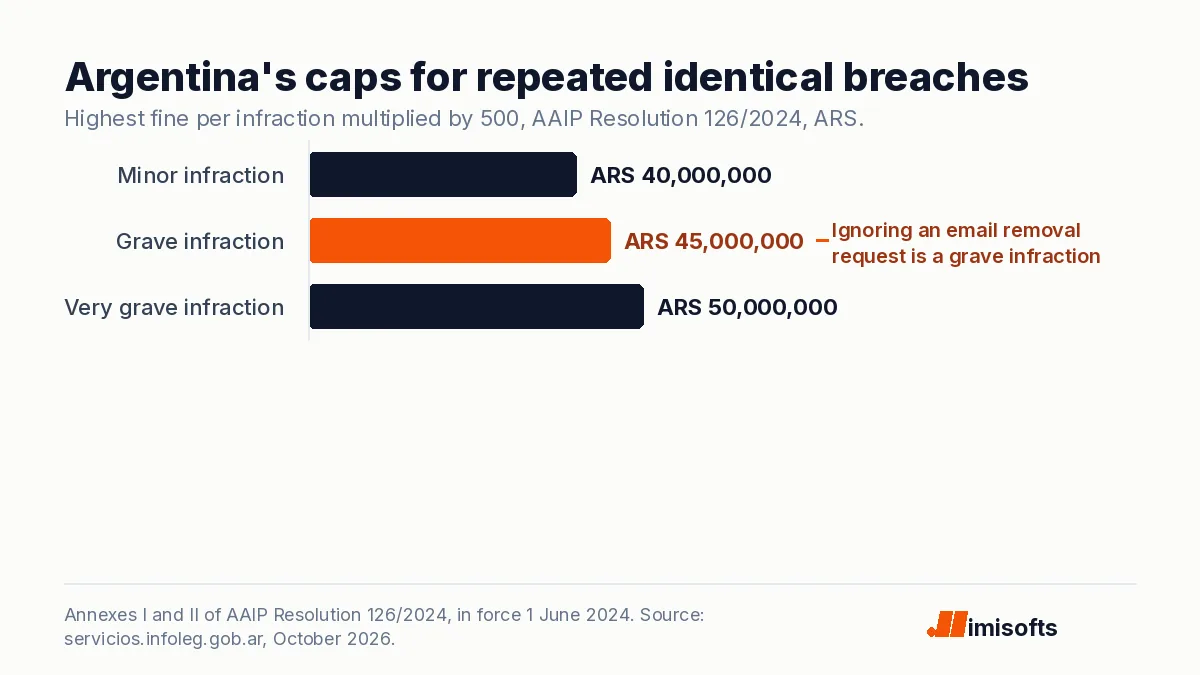
| Cap on identical grave breaches (scale maximum times 500) | ARS 45,000,000 |
| Recidivism window | 3 years |
| No Llame stop period for a newly registered number (email is not covered) | up to 30 days |
| Reform bill presented (bill 3397-D-2026, early stage) | July 16, 2026 |
Law 25.326, Decree 1558/2001, Disposition 4/2009 and AAIP Resolution 126/2024 read on argentina.gob.ar and InfoLEG, the No Llame FAQ and Allende and Brea's note of 12 August 2026, all on 5 October 2026.
What a lawful advertising email to Argentina contains
- A lawful source for the address. Article 27(1) of the Law accepts data from publicly accessible documents, data the person supplied, or data obtained with consent. The Decree also allows advertising data without consent when people are identified only by membership of generic profile groups, plus the individual data strictly needed to make the offer.
- The word publicidad in the header. Article 2 of Disposition 4/2009: when the communication was not requested or consented to, it must be prominently flagged as advertising, and an email must carry the single term "publicidad" in its header.
- A removal notice that quotes the law. Article 1 requires a notice of the right to total or partial withdrawal or blocking from the database, the mechanism for exercising it, and a transcription of Article 27(3) of Law 25.326 and the third paragraph of Article 27 of the Decree. Removal can be partial, blocking only one channel such as email.
- A removal route that works. Article 3 requires the sender to verify that the removal mechanism has enough operational capacity, and under the Decree the sender must, on request, name the database owner that supplied the data.
Fines, No Llame and what is coming
AAIP Resolution 126/2024, in force since June 1, 2024, replaced the 2022 classification and fine scales. Not removing or blocking a name and email address from an advertising database on request is listed as a grave infraction: up to four warnings, a suspension of 1 to 30 days and a fine of ARS 80,001 to 90,000. Processing personal data without registering the database in the National Registry of Databases is a minor infraction, fined at ARS 1,000 to 80,000, and very grave infractions run to ARS 90,001 to 100,000 plus closure or cancellation of the database. The peso amounts are small per breach, but each infraction is sanctioned separately and identical breaches accumulate up to the scale maximum multiplied by 500, so ARS 40,000,000 for minor, ARS 45,000,000 for grave and ARS 50,000,000 for very grave conduct, and a repeat within three years counts as recidivism. The No Llame registry under Law 26.951 covers telephone services in every form, including calls, SMS and instant messaging such as WhatsApp, and AAIP's own FAQ says email is not covered; advertisers get up to 30 days to stop calling a newly registered number. On the horizon, bill 3397-D-2026, presented to the Chamber of Deputies on July 16, 2026, reproduces the government's 2023 reform with a documented proportionality test before legitimate interest can be used, though Allende and Brea note it is at an early stage.
What it means for operators
Argentina is open to cold email in a way Poland and Germany are not, but the format is fixed. Put "publicidad" in the header of every unsolicited email, close with a removal notice that quotes Article 27(3), offer channel-by-channel removal, and push every removal into a suppression list your sending system enforces, which is the core of our email infrastructure builds. Keep a record of where each address came from, because the source test in Article 27(1) is what makes the list lawful, and register the database with AAIP. Phone is different: an AI voice agent or call centre dialling Argentine numbers has to clear No Llame, and AAIP treats calling without the authorised-user access to download the registry, or contracting callers in Argentina or abroad without measures to ensure compliance, as grave infractions too. Our Brazil and Mexico guides cover the other big Latin American markets, and the country-by-country table puts them side by side. For a lead generation programme into Argentina, the label and the removal flow are part of the build, not an afterthought.
Frequently Asked Questions
Yes, without prior consent, if the address comes from a publicly accessible source, from the person or with consent (Article 27(1) of Law 25.326), the email carries the word "publicidad" in its header (Disposition 4/2009), it explains the right to removal with the transcribed text of Article 27(3), and removal requests are honoured.
The single term "publicidad" in the header of an unsolicited email, a notice of the right to total or partial withdrawal or blocking from the database with the mechanism to exercise it, and a transcription of Article 27(3) of Law 25.326 and the third paragraph of Article 27 of Decree 1558/2001. On request, the sender must also name the database owner that supplied the data.
No. AAIP's No Llame FAQ says the registry under Law 26.951 covers telephone services in all their forms, including calls, SMS and instant messaging such as WhatsApp, and that email is not covered. Advertisers have up to 30 days to stop calling a number once it is registered.
Under AAIP Resolution 126/2024, ignoring a removal request is a grave infraction: up to four warnings, a 1 to 30 day suspension and a fine of ARS 80,001 to 90,000 per infraction. Identical breaches accumulate up to the scale maximum multiplied by 500, which is ARS 45,000,000 for grave conduct.